
Common Questions About AMIRI, Answered
Most of what follows is asked by people searching amiri, amiri men, amiri clothing or buy amiri online, and a good number of the questions exist only because a handful of errors will not die. The answers hold to what the house publishes, what court records and trade press show, and what the product pages say. Genuine disagreement between sources is flagged as such rather than papered over. Every price below is an observed market listing gathered in 2026; it is not an official price list. None of this amounts to a valuation, a forecast or investment advice. The house renders itself in capitals, and it is a Los Angeles label that shows in Paris, not a French or Italian one.
Does the brand run an official AMIRI outlet store?
There is not, and this is the answer worth memorising. In a federal court complaint filed in July 2021, AMIRI maintained that it “does not have an AMIRI outlet store, nor has it ever authorized any person or business to operate such a store.” That suit went to the United States District Court for the Central District of California, aimed at an internet service provider accused of hosting a counterfeit site posing as an AMIRI outlet, and it was dismissed that September. No outlet exists anywhere at all, online or physical, and no one has ever had authorisation to run one. Discounted stock does exist legitimately, but it is routed through authorised retailers’ sale sections and the off-price arms of retail groups. If a storefront calls amiri varsity jacket itself an AMIRI outlet, it is not the brand, whatever the site says.
Is all amiri clothing produced in Los Angeles?
No, and that blanket claim is one of the most repeated errors about this label. Country of origin differs style by style, and the brand states it openly on its own product pages. Production of the MX1 jean, the Stack jean and the MA Core Logo Hoodie sits in the United States, and the MA Bar Logo Tee is made in Los Angeles. The MA Core Logo Tee comes from Italy, and both the Skel Top Low and the Skel Court Hi are made in Vietnam. That trips up buyers: a Vietnamese origin stamp inside a Skel-Top is correct, not evidence of a counterfeit. What deserves suspicion is the opposite case, a jean claiming Italian manufacture or a Skel-Top claiming American assembly.
What is the brand’s signature sneaker?
The Skel-Top Low, unambiguously, because it is the only model the brand’s own copy calls its house signature sneaker. The shoe is a basketball silhouette executed in leather and suede over a two-tone rubber sole, with hand-cut bone appliqués picked out in contrast topstitching. Observed pricing sits at $650, against an original retail of $590 at an August 2020 release, which makes anything still quoting $590 stale. Three models are habitually confused with one another, and they are not interchangeable. A canvas retro-court style observed at $690 is the Skel Court; the Stars Court is the same silhouette carrying stars where the bones would be. The Bone Runner is real, but its release year is not documented and it now surfaces mainly at off-price and on resale.
Should the MA-1 be understood as a bomber jacket?
In this line, no, even if the mistake is a natural one. Across the wider market MA-1 is the generic United States military designation for a flight jacket, worn by dozens of labels; here it names a sneaker, observed at $799 in low and high versions. MA is drawn from the founder’s initials and prefixes several sub-lines, with no reference to military naming. Those sub-lines run to MA Bar, MA Core, MA Quad, MA Fit and MA Skyline, reaching across tees, hoodies, denim fits and footwear. MA Bar and MA Core are two different tees, routinely written up as a single thing. No flagship named bomber jacket turned up in the current line, so any article built around one deserves suspicion.
Who started the house, and in what year?
The founder and creative director is Mike Amiri, an American designer of Iranian parentage, and the founding year is genuinely contested. The about page published by the brand puts the founding in his hometown of Los Angeles in 2014, with CFDA and OTB Group in agreement. A PRNewswire release dated December 2014 gives a different year, putting the founding in 2013, in partnership with the Los Angeles retailer Maxfield. Since both stand as citable sources, the safest wording is that the house dates itself to 2014 and the earliest contemporaneous release says 2013. The debut came as an exclusive capsule at Maxfield, attested by the brand and the CFDA. Brand and CFDA copy handle his start generically, as hand-crafting stage pieces for legendary Los Angeles performers, and the rock clients named in retail editorial are reported rather than confirmed.
How many stores does AMIRI operate?
Roughly thirty-three, according to the brand’s own retail-locations page, and that count includes boutiques still marked as coming soon. Trade reporting lands near thirty-one standing boutiques in 2026 after the Milan opening, matching the official list. A widely copied figure of one hundred and ninety-five stores is wrong and should never be repeated. The error appears to be wholesale doors counted as owned stores, given that the brand separately works with about one hundred and fifty wholesale accounts across some four hundred points of sale. Rodeo Drive in Beverly Hills took the first permanent store in 2020, with Milan later becoming the first permanent European location. Anyone publishing a three-figure store count is simply repeating the mistake.
Which amiri jeans style names are genuine?
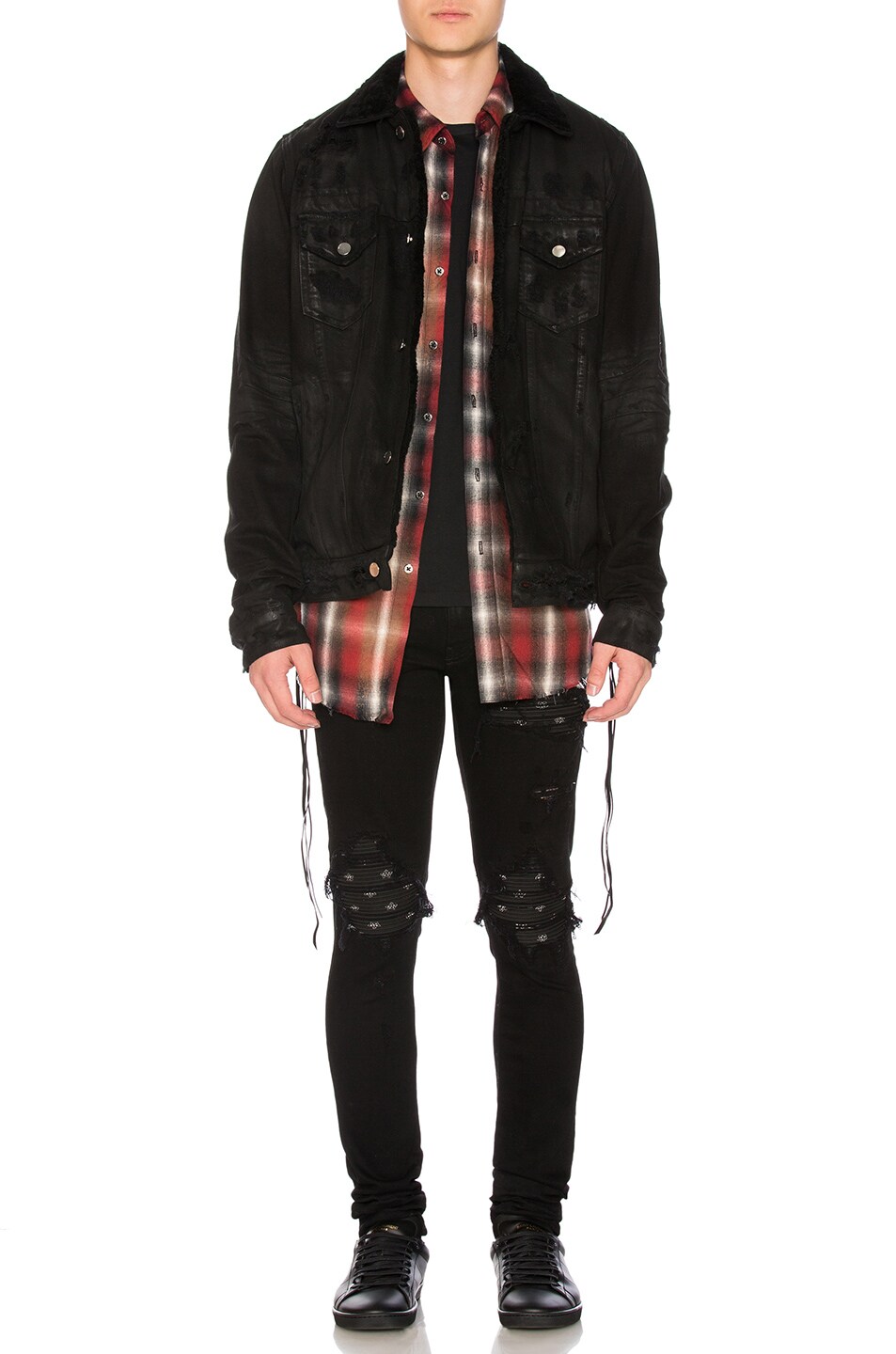
The line breaks down into two kinds of name, and conflating them is the commonest mistake in writing about this brand. On the fit and model side sit the MX1, MX2, Thrasher, Stack, Shotgun, Carpenter, MA Fit and Baggy, along with Repair and Patchwork constructions. Treatments applied across those models include Bandana, Crystal, Stud, Eagle, Aloha and Monogram, so Bandana and Crystal are treatments rather than fits, though a Bandana Repair Straight Jean exists as a full product name. The MX1 is the signature, repaired with pleated ovine leather; the Thrasher is the pure hand-distressed expression without that structured panel; the Shotgun carries blown-out frayed holes with sanded edges. MX3 exists only as a women’s Baggy MX3, a motocross-inspired hybrid observed at $990, rather than a men’s tier above the MX1. A denim name that appears on a third-party list but not on the brand’s own pages is almost certainly descriptive language, not a model name.
What do the principal pieces cost?
Everything below was read from live listings in 2026, which makes these observed market prices and not an official price list. They move, they vary by region and currency, and multi-brand retailers price differently again. In-season reductions of forty to seventy percent have been observed at authorised retailers, with further cuts off-price, so the discounting is built into the market. The entry point is a T-shirt at around $425 to $460; at the other end, worked outerwear such as a varsity jacket has been found listed above $2,300. In every category, the embellished, crystal-set and heavily reconstructed pieces sit clear of the standard band. A core amiri hoodie and a Skel-Top land on the same observed figure, which makes a useful anchor.
| Piece of the line | Observed price, 2026 |
|---|---|
| Stack jean | $750 |
| MX1 jean | $1,090 |
| Baggy MX3 for women | $990 |
| MA Core Logo Hoodie | $650 |
| Skel Top Low | $650 |
| Skel Court Hi | $690 |
| The MA-1 sneaker | $799 |
| Ryder Boot | $1,090 to $1,290 |
Where do I buy, and will the house authenticate a resale purchase?
The only official online shop is the brand’s own site, and every other legitimate seller should appear on the stockists page the house publishes. That page sets out department stores and specialist boutiques across Europe, North America and Asia, along with a shorter list of approved online retailers. Maintenance is lax, as shown by the British retailer that closed in 2024 and is still listed, which makes the page a set of names to recognise rather than a live directory. The awkward case is Farfetch, which does not appear on that official online list but sells through partner boutiques that are stockists, leaving it in neither category. The brand’s position on authentication is stated plainly: it can only verify products bought directly from it or through an authorised stockist partner, and anything bought elsewhere is outside that. No brand-operated authentication app, tag or code verification was found, so provenance and a retained invoice are the practical protection.
How big is the business, and who owns it?
Mike Amiri holds majority ownership and retains creative and operational control. OTB Group, the Italian holding chaired by Diesel founder Renzo Rosso, took a minority stake in 2019 as a strategic partner. Neither the deal terms nor the stake percentage was ever published, which means a quoted percentage anywhere is invented. On scale, the founder said the brand surpassed three hundred million dollars in sales in the prior year, a statement relayed by press rather than an audited figure. The company is privately held, there are no public audited accounts, and the valuation or net-worth numbers in circulation have nothing behind them. Firmer milestones are easier to stand on: a Paris Fashion Week debut in 2018, womenswear in 2021, and the Amiri Prize, launched in 2021, worth one hundred thousand dollars plus a year of mentorship.